
Asteya: What You Might Be Stealing from Yourself
This is the third post in our Yamas and Niyamas series of the Denver Yoga Summit Yamas and Niyamas Series written by Founder/Director Brittany Hopkins Switlick
Ahimsa asked us to stop causing harm. Satya asked us to tell the truth about where harm lives. Asteya asks something specific: stop stealing. Including the joy, the rest, the presence, and the voice that belong to you.

There's a question I used to dread.
"Where do you want to go to eat?"
I would say I didn't care. Every time. And it wasn't true. I had preferences. I had cravings. But somewhere along the way I had decided that my answer mattered less than making sure everyone else was comfortable. That felt like kindness. It wasn't. It was me stealing from my own life, one small preference at a time.
That is Asteya. Or more precisely, that is the opposite of it.
Asteya Means…
Asteya is the third Yama in Patanjali's Yoga Sutras. It is translated most often as "non-stealing." At first glance, that seems like a simple ethical instruction. Don't take what isn't yours.
But the practice cuts much deeper than that. Yes, asteya asks us to look at what we take from others. It also asks us to look at what we take from ourselves. And what we steal by not letting others experience what is rightfully theirs.
We can see the invitation to practice asteya/non-stealing everywhere. Because stealing exists in comparison, in over-giving, in rescue those that don’t need to be rescued, in staying up too late, in the scroll.
Choose Your Hard
This phrase has been sitting with me a lot lately. Life is hard—so choose your hard. The question isn’t whether life will be hard. The question is which hard will you choose? Which hare are you willing to live with?
Marriage is hard. Divorce is hard. Choose your hard.
Being in debt is hard. Financial discipline is hard. Choose your hard.
People-pleasing is hard. Knowing what you want and asking for it is also hard. Choose your hard.
This is Asteya.
When I spent years deferring my preferences to keep others comfortable, I was choosing a particular kind of hard: the slow erosion of knowing what I actually wanted. I told myself it was generosity. But you can't give from a place you've depleted. And over time, I had stolen something from myself that took years to find again. My own voice.
The practice of non-stealing from yourself starts with the small things. What do you actually want for dinner? What do you actually think about that? What would you choose if you trusted that your preference mattered?

Asteya and Our Children
One of my friends has a son who recently bought his first used car. She gave him a list of things to check, things to research, repairs to look for before committing. He didn't listen. He bought the truck. The check engine light is already on. He doesn't even have it registered yet.
She wants to pay for the repairs—of course she does—she loves him and doesn’t want him to suffer. AND she is holding back from that, because she recognizes that stepping in would steal the lesson from him. The discomfort of that truck is teaching him something about due diligence, about consequences, about the cost of not learning from what others have already learned. That’s his to carry right now.
She also mentioned that she is practicing ahimsa by not saying "I told you so." That is both things at once: letting him struggle through, and choosing not to add harm to an already hard moment.
I try this with my three-year-old. There are so many things I could just do for her. Getting her shoes on. Buttoning her jacket. It would be faster and easier and we would all get out the door sooner. But if I rush in every time she struggles, I take something from her. I steal the satisfaction of figuring it out. I steal the small proof that she is capable.
My son still asks me to get his glass and pour his milk. He’s eight. He can do it. And if I spend more time doing for him what he’s perfectly capable of doing, I am taking something that belongs to him, a moment of competence, a small lesson in independence.
Asteya in parenting is one of the harder forms of the practice for me. Because the impulse to rescue comes from love. But love and rescue are not always the same thing.
On the Mat: Comparison Is Stealing
This one is direct.
When you glance at the person next to you in class and adjust your pose based on what theirs looks like, you leave your own body. You trade what is true in you right now for a standard that has nothing to do with you.
That’s stealing. You take yourself out of your own experience and put yourself in someone else's. And neither of you benefits.
Asteya on the mat looks like staying in your body. It looks like caring about what you feel, not what the pose looks like from the outside. It looks like adapting the poses because the stepping up or backing off is actually what your body needs today.
Your practice belongs to you. Comparison steals it.
Off the Mat: What We Take from Tomorrow
My husband and I stay up late watching TV. One more episode becomes two. We both know we will pay for it the next day. We pay in tiredness and in patience. The version of me at 7am after too little sleep is a different parent than the one I want to be. The bummer is that we’re not just stealing sleep. We’re also stealing from our children the version of their mother who shows up with space and steadiness.
This is a form of Asteya I had not thought about until recently. The things we take from our future selves. The rest we don't protect. The margin we don't build. The boundaries we don't keep. Tomorrow pays the price for the choice we make tonight.
The Studio Scroll
When I was a new studio owner, I spent a lot of time on social media. I would see other studios posting photos from packed classes. Mine were not packed. And the comparison would settle into me in a way that made it hard to focus on what I was creating.
I had to unfollow people I genuinely love and support because I couldn’t manage my own ego while watching. I was stealing from my own clarity every time I scrolled into someone else's highlight reel and measured my behind-the-scenes against it.
That was not sustainable. Leaving was Asteya in practice. Protecting my attention, creative energy, and belief in what I was doing. That is non-stealing.
The practice asks: what are you looking at that takes something from you every time?
A Journal Practice: Asteya Inquiry
Find a quiet seat. Take three slow breaths.
Then sit with these questions, one at a time.
1. Where am I stealing from myself? What preferences, wants, or needs do you consistently defer, minimize, or ignore?
2. Where am I rescuing someone from something that belongs to them? A child. A partner. A friend. A student. What lesson, consequence, or experience are you stepping in front of that’s not yours to carry?
3. Where is comparison costing you? On the mat, on your phone, at work. Where are you leaving your own experience to measure yourself against someone else's?
4. What are you stealing from tomorrow? What choices are you making today, around rest, margin, boundaries, that your future self will pay for?
Take one thing from this inquiry. Just one. Carry it through the week and notice what it shows you.
For Yoga Teachers: Asteya and Your Authority
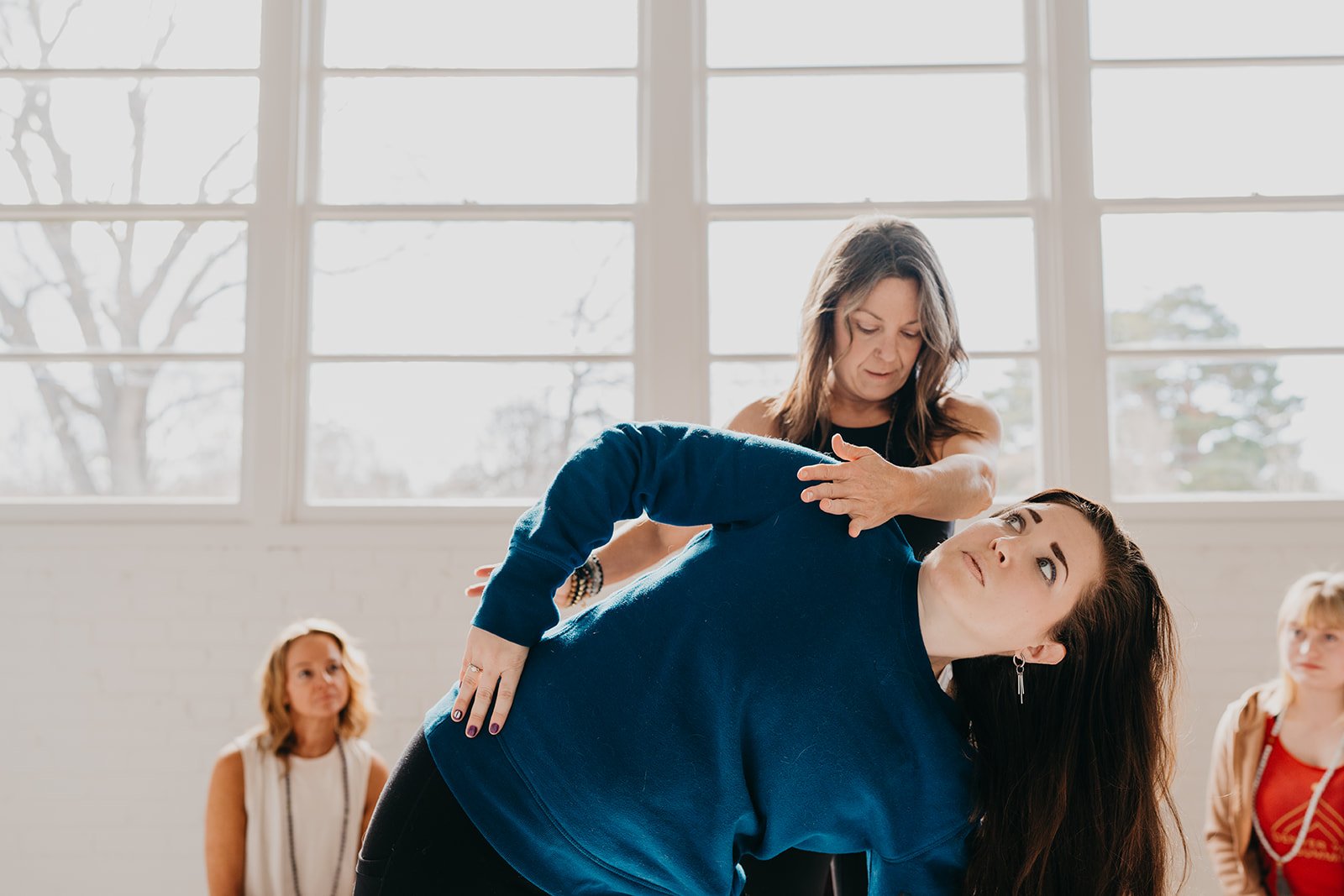
As teachers, we can steal from our students without meaning to.
We steal from them when we give them the answer before they've had time to discover it themselves. We steal from them when we over-correct a pose that is actually fine, but doesn't match our mental image of what it “should” look like. We steal from them when we fill every moment of silence with instruction, leaving no room for them to feel their own experience.
Great teaching knows when to step back. When to let the student be in their body without commentary. When the most generous thing you can offer is space.
There is also a version of Asteya that applies to how we carry our students' struggles. If a student is going through something hard, it can be tempting to feel responsible for fixing it. But their growth is theirs. Witnessing it without needing to resolve it is one of the more advanced forms of this practice.
Join Us for the May Reconnection Reset
This month we are hosting two Reconnection Reset gatherings, and both are free.
Saturday, May 16th | 6:00 to 7:30 PM FORMATION Yoga. Strength. Wellness. in Littleton
Saturday, May 30th | 12:00 to 1:30 PM Converge Yoga. Fitness. in Thornton
Asteya Carries You to September
Ahimsa asked us to stop causing harm. Satya asked us to tell the truth about where harm lives. Asteya asks something specific: stop stealing. Including the joy, the rest, the presence, and the voice that belong to you.
At the Denver Yoga Summit, September 11 to 13 at Denver Botanic Gardens at Chatfield Farms, we will spend three days inside these teachings together. In community, in nature, with teachers who practice this honestly.
Community pricing is now $444.

Brittany Hopkins Switlick is the Founder and Director of the Denver Yoga Summit and an E-RYT 500 with over a decade of teaching and teacher training experience. She is the author of Dancing with Our Selves. This post is part of an ongoing series exploring the Yamas and Niyamas as a framework for living yoga off the mat.
Denver Yoga Summit, September 11–13, 2026, Denver Botanic Gardens at Chatfield Farms, denveryogasummit.com/tickets