

There's a joke I make in class that always lands.
I tell my students that one of the most powerful practices in yoga is to stop "should-ing" on yourself.
I should be better at this by now. I shouldn't have said that. I should know how to do this pose. I should be further along.
That voice is relentless. And most of us have been living with it so long that we don't even notice it anymore. It feels like honesty. It feels like accountability. It isn't. It is violence. Quiet, constant, and almost entirely invisible because it lives inside us.
That is where ahimsa in daily life begins. Not with grand gestures toward peace. With honest attention to where you are already causing harm, especially to yourself.
The "Should" Voice Is Himsa
The word ahimsa comes from the Sanskrit himsa, meaning harm, and the prefix a, which negates it. Non-harming. The opposite of ahimsa is himsa: violence, harm, hurt.
The "should" voice is himsa. It is the part of us, what yoga philosophy calls the ego, that measures, compares, and finds us consistently falling short.
I've named that part of myself Brandi. It helps me create enough distance to notice what's happening instead of being swept up in it. When I can say "there's Brandi again" instead of simply believing every word she says, I have a little more room to choose differently.
The first practice of ahimsa in daily life is just this: notice the "should" voice. Not silence it by force, which is its own kind of violence. Just notice it. Name it. And ask whether what it's saying is actually true, or whether it's a habit.
What Ahimsa Actually Asks of Us
Nischala Joy Devi translates ahimsa as "compassion and reverence for all beings and all things." That word "all" is important. You are in that.
Ahimsa in daily life asks you to extend to yourself the same quality of care you would offer a person you love. Not infinite permissiveness. Not avoidance of accountability. Honest care. The kind that sees clearly and responds with warmth instead of attack.
Don Miguel Ruiz offers something useful here. His fourth agreement, always do your best, carries a quiet caveat: your best is different from moment to moment. Some days your best is a full practice, a patient conversation, a class you're proud of having taught. Other days your best is getting out of bed. Ahimsa requires that we let both count.
Your Schedule Is Telling You Something
One of the most violent things I do to myself is my calendar.
A jam-packed schedule is an act of harm. I know this. I've lived it. And I keep coming back to it because the world rewards busy people, and slowing down can feel like falling behind.
But the question ahimsa asks is not "am I productive enough?" It is "what does adding this actually cost?" Cost to your nervous system. Cost to your presence at home. Cost to the quality of attention you have for anything, including yourself.
It takes courage to do less. It takes courage to protect your children from a schedule that pulls them in six directions before they're old enough to ask for it. It takes courage to cancel something that was never really yours to carry.
That courage is the practice.
Ahimsa Toward People Who Make It Hard
Here's where this teaching gets genuinely difficult.
It is relatively easy to be compassionate toward people who are easy to be compassionate toward. Your close friends. Your students who show up consistently. The people who share your values.
Ahimsa toward the person who frustrates you, whose choices feel incomprehensible, whose behavior makes you want to close the door completely, that is a different ask entirely.
Deborah Adele writes that we are all in the human basket. It is a mixed bag. The more willing we are to look honestly at the violence that lives in us, the harsh judgment, the dismissal, the moments we mentally "should" someone else into a corner, the more we stop becoming the very thing we are reacting against.
Ahimsa is not passivity. It is not condoning harm or staying quiet when something is wrong. It asks whether your response is coming from clarity or from reaction. Those produce very different actions in the world.
A Practice for This Week
Pick one moment each day when you notice a "should" arising. On the mat, in traffic, in a conversation, wherever it shows up.
When you catch it, don't fight it. Just name it: there's a should.
Then say to yourself: it makes sense that I feel this way. That's all. A simple moment of acknowledging that whatever is arising has a reason. Then feel your feet in your shoes and your breath in your nostrils.
If you want to go deeper, try a Metta (loving-kindness) meditation. It begins with yourself and moves outward, which is exactly the direction ahimsa asks us to travel.
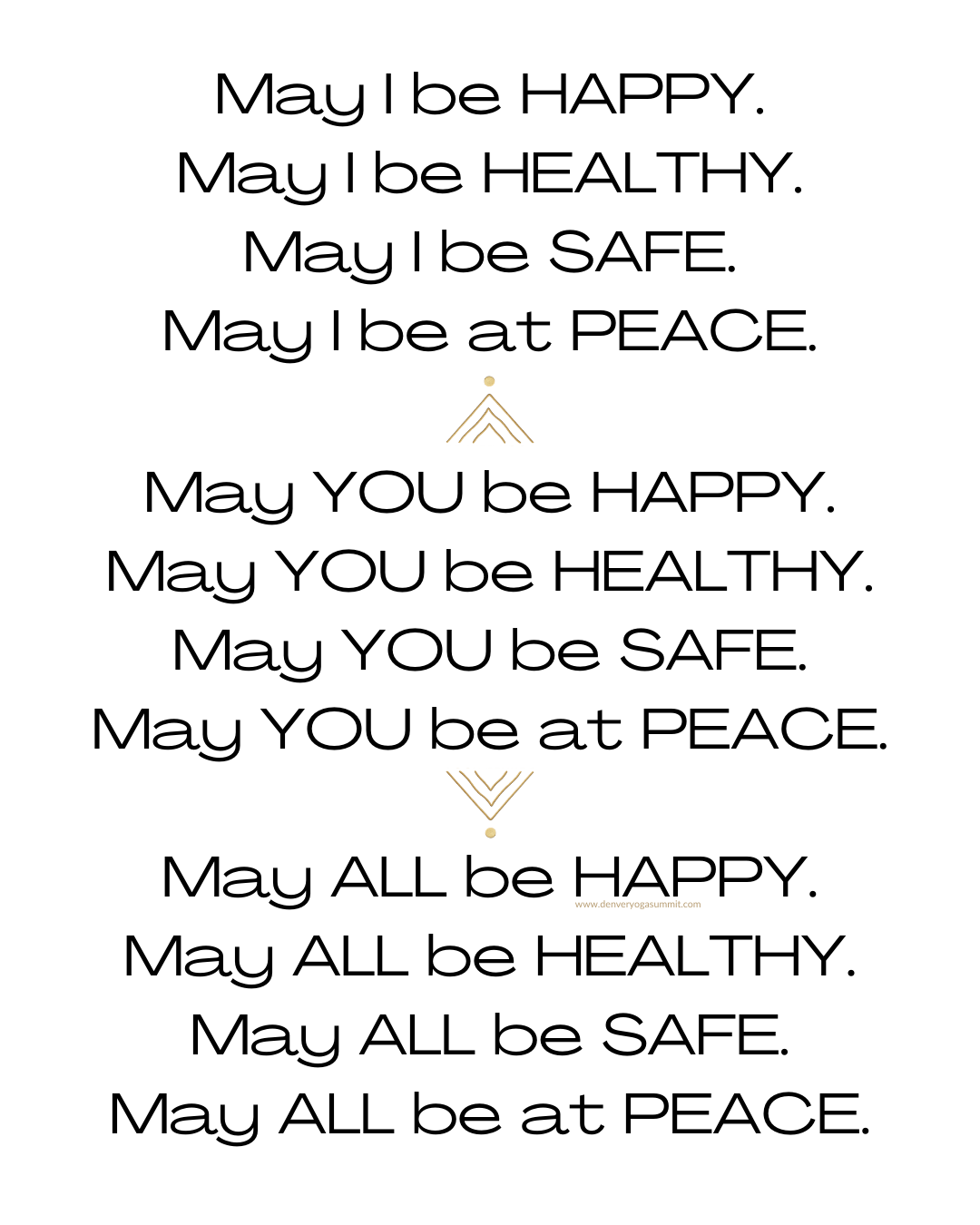
Start with yourself. Repeat it until it feels less strange. Then extend it: to someone you love easily, to someone neutral, to someone difficult. The practice is not about feeling warm toward everyone immediately. It is about training the direction of your attention.
Journal Prompts: Ahimsa Inquiry
Find a comfortable seat and take three slow breaths. Then sit with these questions, one at a time. Write without editing yourself.
1. What does your inner voice say to you most often? Write it down exactly. Then ask: would you say this to someone you love?
2. Where in your daily life are you running on empty and calling it dedication? What would it mean to treat your own energy as something worth protecting?
3. What are you tolerating, in a relationship, a commitment, a habit, that you would never advise a friend to tolerate? What would ahimsa say about that?
4. Who in your life is hardest to extend compassion toward right now? Not to excuse their behavior. Just to hold them in the human basket. What would that feel like?
Carry one thing from this inquiry into your week.
This post is part of the Denver Yoga Summit's Yamas and Niyamas series. Start with What Is Ahimsa? The Yoga Philosophy of Non-Violence or continue to Ahimsa for Yoga Teachers.
Brittany Hopkins Switlick is the Founder and Director of the Denver Yoga Summit and lead teacher at Lotus Yoga School. She is an E-RYT 500 and author of the Amazon #1 New Release Dancing with Our Selves.
Post updated March 5, 2026